
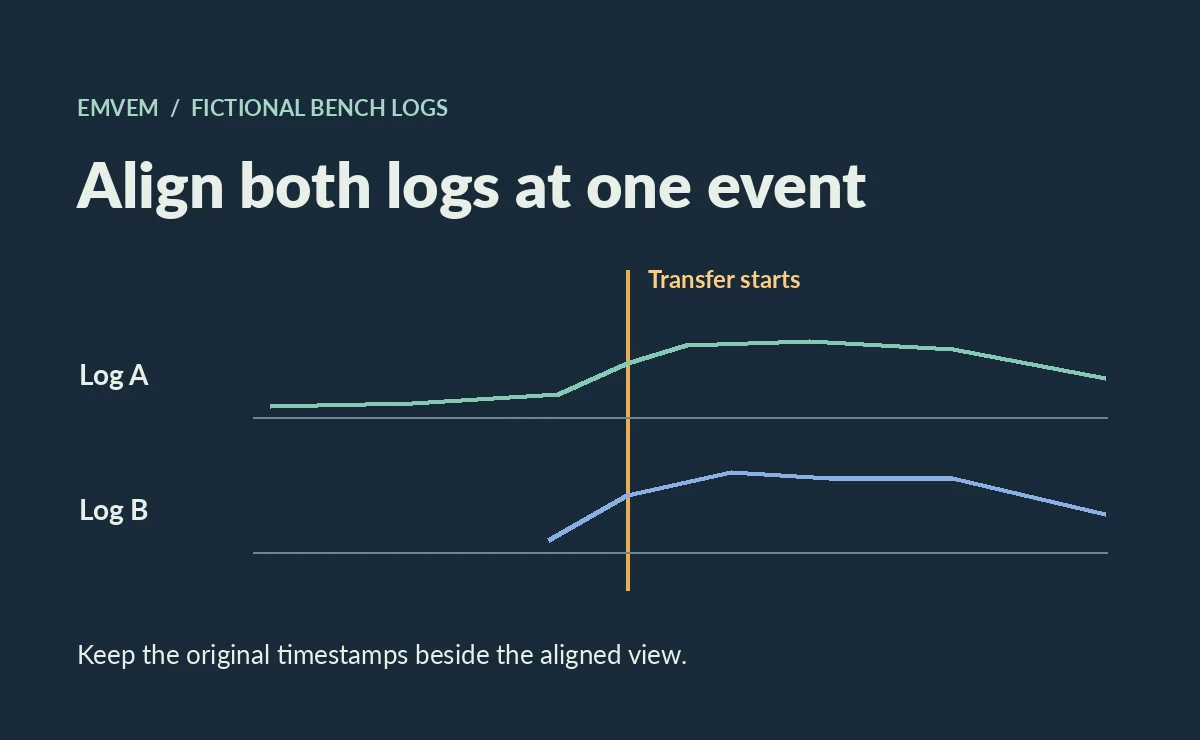
Two machine logs can have good measurements and still be hard to compare if they start at different moments. A shared reference event, such as the moment a defined task begins, makes it possible to see which stretches of the two logs describe the same work.
Find the task before you align the curves
Consider a fictional comparison between two electrically driven test rigs completing the same material transfer. The first logger starts as its operator enables the rig. The second starts once material is moving. A chart with both traces starting at zero gives the impression that the opening seconds describe the same task. One trace includes setup and the other begins later.
Define what starts and ends the comparison you intend to make. If the question concerns the entire batch, record enable, active transfer, pauses and return to a ready state. If a report describes energy during the transfer alone, identify the first and last observations that belong to that interval. Both measurements can be useful when their boundaries are visible.
Choose a reference event you can find in both records
Suppose the first log identifies the start of transfer at 00:42, and the second identifies it at 00:08. Put a vertical mark at each point and align the charts on that event. Retain the original timestamps beside the result. If the first log covers 20 seconds of setup and the second has no recorded setup interval, label the gap. Filling the gap with zero would claim that the logger observed no power there.
Record a short definition beside the aligned chart: “Transfer starts when the load begins to move and ends when it reaches the marked destination.” Someone reviewing the figures can then ask whether both records used the same definition and how the event was identified. Where the marker came from an operator’s note, say so. A timestamp written down afterwards has a different basis from a sensor record.
Keep the aligned view and the source log
A shared clock is one part of a fair comparison. Review the load, the work completed, the scope of the measurement and what was excluded. The historical EMVeM final report places energy efficiency in the wider study of mechanical and mechatronic systems. The fictional logging example here offers a narrow way to keep that system context visible alongside a graph. EMVeM final report on CORDIS.
For the next comparison, save both originals, name one reference event and record which intervals were observed. That gives a reviewer enough information to check whether an apparent difference belongs to a machine, a task or the way the two logs were aligned.