
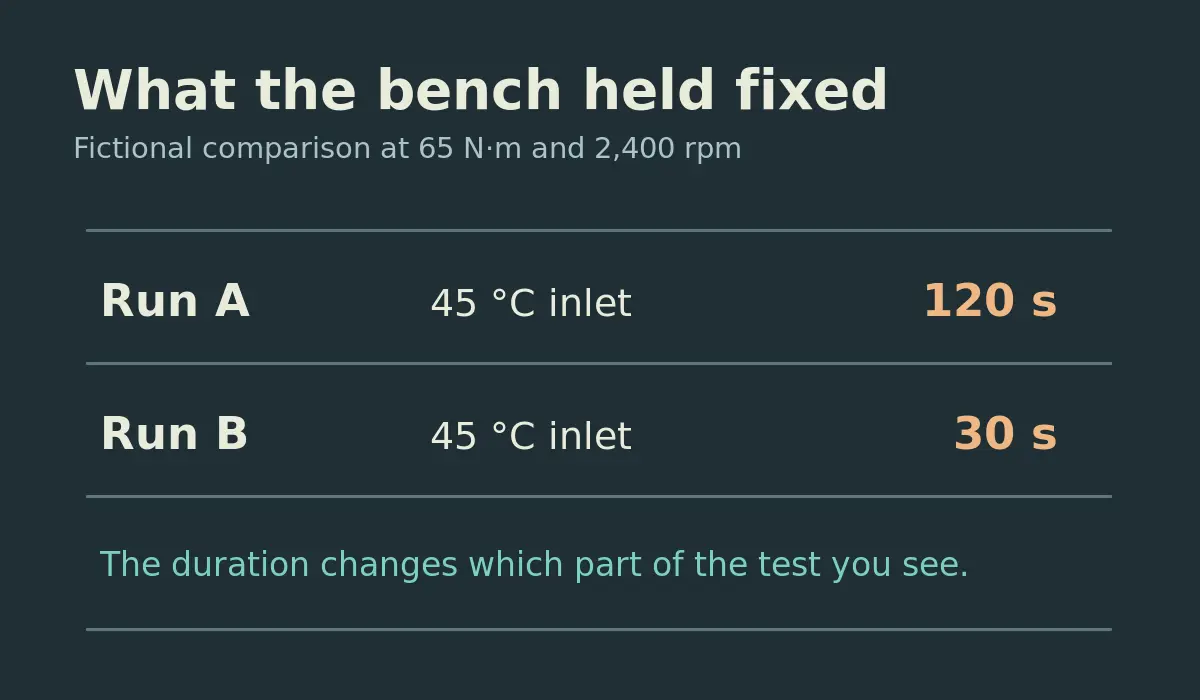
Two bench logs name the same motor speed and torque. The first reports an average electrical input of 17.6 kW. The second reports 17.3 kW. A spreadsheet can subtract one figure from the other straight away. The report still has to establish that the instruments were looking at comparable parts of the runs.
In the fictional logs, the motor runs at 2,400 rpm and 65 N·m, for about 16.3 kW of mechanical output. Both logs identify a coolant inlet setting of 45 °C and the same electrical measurement boundary. Run A averages 120 seconds after a steady period. Run B averages the first 30 seconds of the loaded run. Even if the inlet temperature agrees, the temperature of a winding or other components may differ. A coolant setpoint describes the circulating fluid at a stated point in the test.
Which part of the run is the comparison?
A cold first interval can answer an engineering question if both tests deliberately start from the same thermal state and record the same fixed duration. A warmed-up average can answer another question if there is evidence that relevant temperatures had settled. The fictional numbers mix those windows. Pulling the inlet reading for run B out of its time record gives no reliable account of when the electrical value was measured.
Oak Ridge National Laboratory’s 2010 Prius evaluation makes timing and thermal conditions visible in its continuous-load section. Section 3.5 lists power levels, speeds and coolant temperatures used for these tests and says that motor temperatures were allowed to stabilise before the continuous tests began. The ensuing records show temperatures over time and label the measurement locations. This is a bench record for a particular benchmark, useful for seeing how these conditions accompany a result. ORNL report, section 3.5 and Figures 3.22–3.24.
With the fictional logs, the next reading step is to recover the timed traces and identify an interval that answers the same question in both runs. A comparison note can then carry the torque-speed point, temperature location and timing, and the electrical measurement points. The two headline input figures are worth keeping in their original context while that check is unresolved.